
Last Updated: March 2026
I’ll never forget the phone call from a manufacturing client last spring. Their NetSuite renewal quote had just arrived, and the price had jumped 87% from their initial contract. Not a typo. Eighty-seven percent.
“We were told this was scalable pricing,” their CFO said. “Instead, we’re being held hostage.”
This wasn’t isolated. Over the past three years, we’ve talked to dozens of companies facing the same NetSuite sticker shock at renewal. The pattern is consistent: attractive initial pricing, aggressive sales tactics, then massive increases when contracts renew. Many of these conversations end with: “What about Acumatica?”
The Acumatica vs NetSuite decision has become one of the most common evaluation scenarios we see. Both are cloud-based systems targeting similar company sizes, but the similarities end there. The real differences show up in how these vendors treat their customers, structure their pricing, and deliver on their promises.
Why Customer Satisfaction Numbers Matter
When comparing Acumatica vs NetSuite, we recommend you start with how existing customers feel three years down the road.
Acumatica’s Net Promoter Score sits at +46. NetSuite’s is +5. That eight-fold difference tells you something fundamental about how these vendors operate.
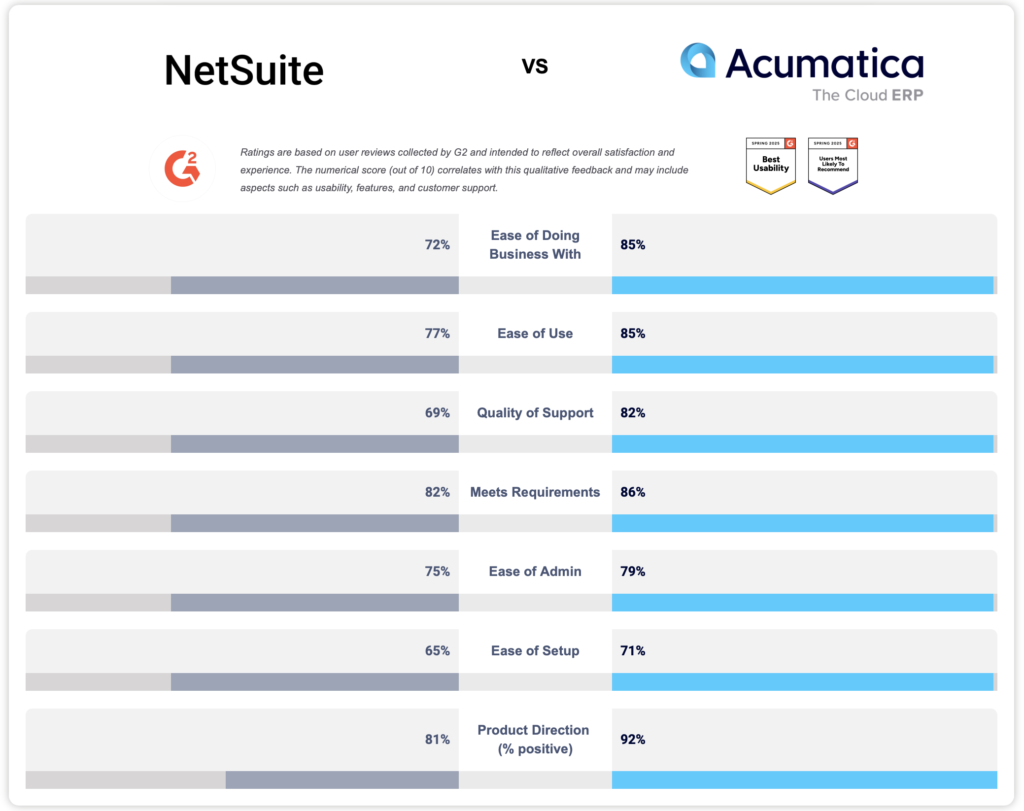
G2’s 2025 ratings back this up across every metric. Acumatica scores 85% on ease of use compared to NetSuite’s 77%, setup is easier, administration is more straightforward, and as a good business partner, Acumatica gets 85% while NetSuite manages just 72%.
The Acumatica implementations we’ve done typically move smoothly from go-live into optimization mode, with ROI showing up around 17 months. With NetSuite migrations, we hear about prolonged usability struggles, unexpected costs, and ROI timelines stretching past 22 months.
For a detailed side-by-side breakdown of how these platforms compare, download our Acumatica vs NetSuite comparison guide.
The NetSuite Pricing Trap
Here’s how NetSuite pricing typically unfolds. The sales team comes in with an aggressive quote, often 40-60% below list price. You sign a multi-year contract. Everything seems fine.
Then renewal hits. Your new quote isn’t based on the discounted rate you’ve been paying. It’s based on “then-current list price.” That manufacturing client? Their per-user fees went from $99 to $120/month, service tier costs doubled, and features they’d been using became “add-on modules” with new price tags.
When they tried reducing user count to control costs, they discovered NetSuite’s pricing doesn’t scale down proportionally. Base fees and service tiers stay high regardless of how many licenses you cut. Do your homework, and look years down the road at the costs.
The Acumatica vs NetSuite pricing comparison looks completely different. Acumatica uses consumption-based pricing with unlimited users included. No per-user fees. No surprise charges when you add seasonal workers or give your accountant access during audit season. And Acumatica provides price increase protection for life, giving you predictable budgeting as your company grows.
What Unlimited Users Actually Means
NetSuite’s per-user model at roughly $120/month means:
- 10 users = $14,400/year
- 25 users = $36,000/year
- 50 users = $72,000/year
Add service tier fees, storage costs, and modules for functionality you assumed was included. A mid-sized distributor we worked with last year was paying over $90,000 annually for 35 NetSuite licenses before switching to Acumatica.
With Acumatica, those 35 users cost nothing extra. Neither do warehouse workers who need occasional access, outside consultants during busy seasons, or external auditors pulling reports.
One client told us they’d been rationing NetSuite access like a scarce resource. Department managers shared logins. Warehouse staff couldn’t access the system directly. The workarounds cost more than the license fees they were avoiding.
After moving to Acumatica, they gave access to everyone who needed it. Collaboration improved. Data accuracy went up because people entered information directly instead of routing it through gatekeepers.
Five-Year Cost Reality
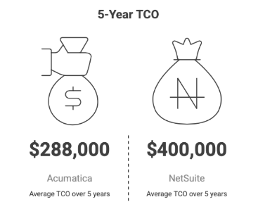
When evaluating Acumatica vs NetSuite over a realistic timeline, the total cost of ownership diverges significantly.
For a typical mid-market deployment, Acumatica’s five-year TCO runs $276,000-$300,000. Annual increases stay predictable, usually capped around 5%. No surprise renewal fees.
NetSuite’s five-year TCO for the same deployment typically lands between $350,000-$450,000 or higher. The initial quote might look competitive, but Years 3-5 carry the weight of renewal increases and growing user counts.
That $100,000+ difference represents real money mid-market companies can redirect toward growth instead of software licensing fees.
Why Usability Affects Your Bottom Line
Companies underestimate the cost of poor usability constantly. They focus on features and pricing, then get blindsided by adoption problems after go-live.
NetSuite consistently gets criticism for being unintuitive and hard to navigate. Users complain about steep learning curves, multiple ways to complete the same task, and performance issues. These aren’t minor annoyances—they add up to thousands of hours of lost productivity.
Acumatica has won multiple usability awards for good reason. The interface uses color-coded next-step keys that guide users through processes. Customization is straightforward without requiring developers. Generic inquiries expose all your data for analysis without complex report building.
Higher usability means faster adoption, lower training costs, and better retention. When your staff can actually use the system efficiently, you see ROI faster.

How Vendor Philosophy Shows Up
The Acumatica vs NetSuite comparison ultimately comes down to vendor philosophy. Acumatica backs its approach with a formal Customer Bill of Rights guaranteeing clear pricing, unlimited users, full customization rights, and transparent contracts.
NetSuite operates under Oracle’s ownership with different priorities. The direct sales model creates pressure to maximize revenue per customer. The pricing structure escalates over time. Multi-year contracts lock customers in before true costs become apparent.
We’ve seen this in how vendors handle problems. When an Acumatica client hits implementation challenges, we work together with Acumatica’s support team to solve it. When NetSuite clients hit problems, they often feel like they’re negotiating against their vendor instead of partnering with them.
The Partner Ecosystem Difference
NetSuite, under Oracle, operates primarily through direct sales with partners functioning as implementation arms of Oracle’s sales engine. You’re ultimately dealing with Oracle’s priorities and processes.
Acumatica maintains a true channel-first model built around independent VARs like Parallel Solutions who own the customer relationship from sales through ongoing support. We’re building long-term partnerships with clients, creating industry-specific solutions, and providing local support a direct model can’t match.
This means two layers of support: Acumatica’s core product team plus your VAR’s industry expertise and personalized service. When you hit an issue at 4pm Friday, you’re calling someone who knows your business.
Making the Right Choice
The ERP selection process shouldn’t be about the slickest sales presentation or the most aggressive initial discount. It should be about finding a partner who will support your growth without extracting escalating fees every time you add users or renew your contract.
When we walk companies through the Acumatica vs NetSuite evaluation, we focus on total cost of ownership, not just Year 1 pricing. We look at how the vendor treats customers three and five years into the relationship. We examine whether the platform will support your team’s productivity or create daily friction.
Watch this 3 minute video on real-life businesses and why they chose Acumatica over NetSuite.
And, that manufacturing client who called about the 87% price increase? They’re running on Acumatica now. Their team has full access without worrying about license counts. Their costs are predictable. Their CFO isn’t bracing for renewal shock every year.